





1. MMS3410 Product Overview
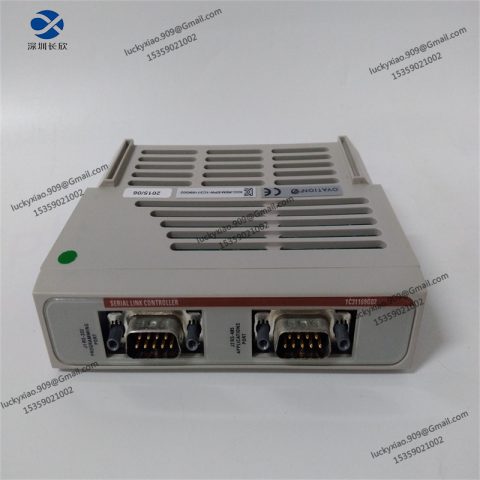
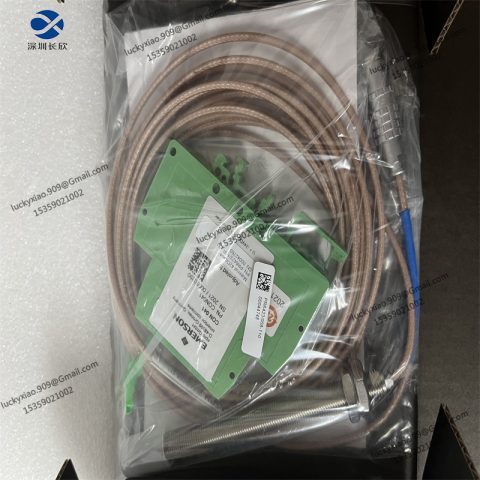
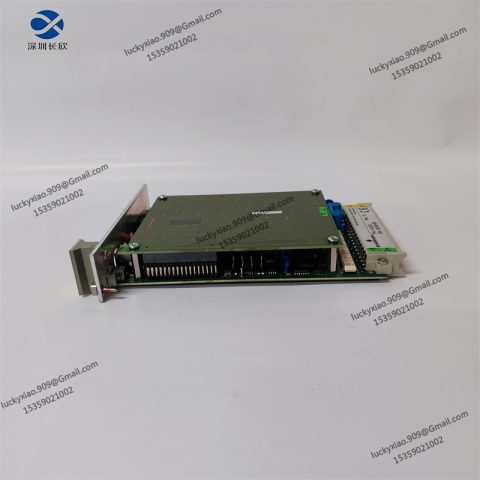
EPRO MMS3410 is a high-precision dual-channel casing expansion transmitter. Specifically, it belongs to the EPRO MMS6000 series TSI (Turbine Supervisory Instrumentation) system. Notably, it specializes in real-time casing thermal expansion displacement monitoring for large rotating machinery. On top of that, it matches perfectly with PR9350 series displacement sensors. Ultimately, it provides accurate thermal expansion data for turbine safety operation and state evaluation.
2. MMS3410 Core Technical Specifications
To begin with, this module features dual independent measurement channels. Primarily, it supports synchronous collection of two sets of casing expansion displacement signals. Importantly, it covers multiple standard measuring ranges from ±12 mm up to ±150 mm. As a result, it adapts diverse thermal expansion stroke demands of different turbine units. Furthermore, it meets full-range monitoring requirements for industrial rotating equipment.
Apart from range flexibility, it owns excellent signal processing performance. Specifically, it supports a 0–100 Hz effective signal frequency response range. Meanwhile, it maintains ultra-stable signal sampling and conversion efficiency. Correspondingly, it captures dynamic thermal displacement changes in real time. Additionally, it avoids signal distortion caused by frequency mismatch.
Beyond signal performance, it delivers standard industrial output parameters. Specifically, it provides two isolated 4–20 mA analog current outputs. Therefore, each channel outputs independent linear displacement signals. Moreover, it allows a maximum load resistance of 500 Ω. Consequently, it adapts long-distance signal transmission and upper system docking stably.
Furthermore, it boasts reliable environmental adaptability. Specifically, it operates steadily from -40°C to +70°C ambient temperatures. Therefore, it copes with drastic temperature changes in turbine workshops. Moreover, it works normally under 5%–95% non-condensing humidity. Consequently, it resists thermal aging and environmental interference for long-term continuous operation.
3. Hardware Design & Structural Advantages
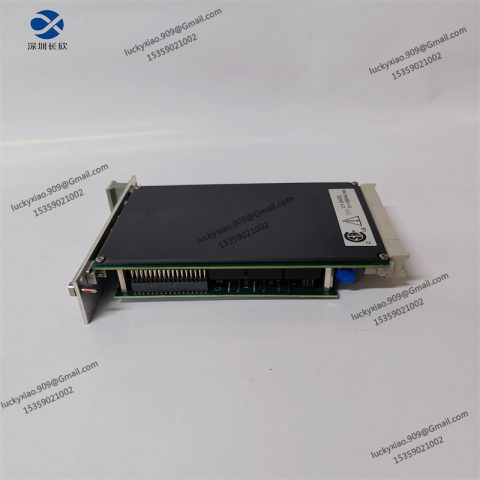
First and foremost, it adopts a standard rack-mounted modular structure. Accordingly, it fits unified installation slots of MMS6000 series systems. Meanwhile, it features high circuit integration and compact layout. Besides, it uses industrial-grade anti-aging electronic components. For this reason, it achieves low failure rate and extended service life onsite.
In addition to structural merits, it builds professional anti-interference design. Specifically, it integrates internal signal filtering and surge suppression circuits. Meanwhile, it complies with strict industrial EMC electromagnetic compatibility standards. Furthermore, it isolates dual-channel signals mutually. Thus, it eliminates crosstalk and external electromagnetic noise interference. As a result, it stabilizes long-term measurement accuracy greatly.
Furthermore, it adopts practical field-oriented design. Naturally, it equips standardized isolated wiring terminals. Hence, it ensures safe and convenient cable connection. Meanwhile, it supports offline parameter configuration and online real-time debugging. Accordingly, it simplifies daily maintenance, calibration and module replacement workflows.
4. Functional Characteristics & Application Value
In terms of core functions, it undertakes key turbine casing expansion monitoring tasks. Specifically, it receives displacement induction signals from PR9350 series sensors. Then, it converts weak original signals into standard 4–20 mA analog outputs. Moreover, it transmits valid data to DCS and TSI monitoring systems steadily. Thereby, it reflects real-time thermal expansion and cold contraction states of turbine casings. Also, it supports unit thermal state judgment and fault early warning.
Besides basic monitoring functions, it enhances unit operational safety. Namely, it tracks thermal displacement changes during unit start-up, load variation and shutdown. Accordingly, it avoids unit abrasion and structural stress damage caused by abnormal expansion. Thus, it applies widely to thermal power plant steam turbines, gas turbines and large industrial rotating machinery. Ultimately, it improves equipment operational stability and fault prediction capability.
5. Recommended Similar Series Models
Lastly, the EPRO MMS6000 series includes diverse TSI monitoring modules. Specifically, they meet different vibration, displacement and state monitoring demands for rotating machinery. For your reference, below are highly compatible mainstream models.
MMS3210: First, it is a classic dual-channel shaft position monitoring module. Specifically, it focuses on shaft displacement and axial position signal acquisition. Moreover, it features high measurement precision and stable performance. Therefore, it suits turbine shaft state real-time monitoring scenarios. Meanwhile, it maintains full system compatibility with MMS3410.
MMS6140: Firstly, it acts as a multi-channel vibration monitoring module. Notably, it supports four-channel synchronous vibration signal collection. Thus, it supplements vibration state monitoring functions for casing expansion measurement. Furthermore, it realizes multi-dimensional equipment state perception. For this reason, it builds comprehensive TSI monitoring systems.
MMS6210: Primarily, it is an upgraded dual-channel shaft displacement transmitter. Importantly, it expands self-test and fault diagnosis functions. Specifically, it improves module operational reliability and maintainability. Furthermore, it cooperates with MMS3410 to monitor turbine key operating parameters. As a result, it enhances overall system safety protection capability.
MMS6310: Basically, it is a dedicated speed and zero-speed monitoring module. Notably, it undertakes turbine rotational speed signal acquisition and judgment. Specifically, it matches displacement and expansion monitoring modules. Furthermore, it realizes linkage monitoring of mechanical operating states. Consequently, it forms complete rotating machinery safety supervision systems.



There are no reviews yet.