





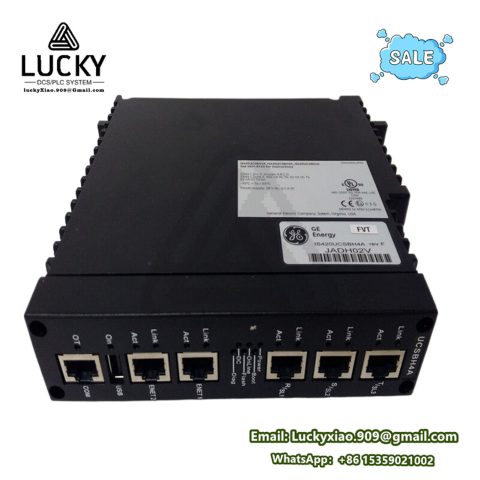
GE IS220PAICH2A Product Overview
IS220PAICH2A Product Introduction
The GE IS220PAICH2A is an analog input pack built for the Mark VIe turbine control platform. It reads 4–20 mA signals from pressure, vibration, level, and position transmitters across isolated channels. Its per-channel filtering rejects noise from nearby variable-frequency drives, so the control loop sees clean process data.
IS220PAICH2A Technical Specifications
Analog input packs decide how faithfully the controller sees the physical process. The table below lists the core parameters that define measurement accuracy and noise immunity.
|
Parameter
|
Value
|
|---|---|
|
Module Type
|
Analog input I/O pack
|
|
Platform
|
GE Mark VIe turbine control system
|
|
Input Signal
|
4–20 mA DC current loop
|
|
Channel Isolation
|
Per-channel galvanic isolation
|
|
Backplane
|
Mark VIe Ethernet I/O network
|
|
Update Rate
|
Configurable per-channel scan, deterministic
|
|
Operating Temperature
|
-30°C to +60°C
|
|
Storage Temperature
|
-40°C to +85°C
|
|
Relative Humidity
|
5% to 95% non-condensing
|
|
Front Panel
|
Channel status LEDs, Ethernet link indicators
|
Loop Wiring and Calibration
A 4–20 mA loop is simple on paper: a transmitter sends a current, the pack measures it, and the controller converts it to engineering units. The details decide whether that conversion is trustworthy. The IS220PAICH2A sources or sinks loop current through its terminals, and the shield on each twisted pair grounds at one end only — a single-point grounding scheme that avoids ground-loop voltages fighting the measurement.
Commissioning walks through each channel. Technicians land the transmitter wires on the terminal block, open the Mark VIe Toolset, and set the signal type and scaling — for example, a 0–160 bar steam pressure transmitter maps 4 mA to 0 and 20 mA to 160. Then they hold a multimeter in series with the loop and compare the measured current against the pack’s displayed value. Agreement within the transmitter’s accuracy class confirms the channel is good.
For daily operation, the pack needs no recalibration. It scans continuously, publishes values over Ethernet, and flags open-circuit or over-range conditions as faults rather than real readings. When a channel drifts, the multimeter check is still the fastest way to separate a transmitter fault from a pack fault.
Application Areas
Analog input packs sit wherever a process variable changes continuously — pressure, temperature, level, vibration — rather than switching on or off.
-
Turbine process measurements — main steam pressure, exhaust temperature, fuel gas pressure, and gland steam pressure.
-
Auxiliary system monitoring — lube-oil pressure, seal-oil differential, and vacuum condenser pressure.
-
Generator and exciter inputs — excitation current, voltage regulator output, and bearing vibration trends.
-
Balance-of-plant loops — feedwater flow, condenser level, and circulating water pressure signals.
Across these signals, the pack’s job is quiet but essential: turn a 4–20 mA current into a number the controller can act on without hesitation.
Recommended Same-series Modules
The Mark VIe I/O family covers both sides of the control loop. The modules below handle functions this analog input pack does not perform.
-
IS420UCSCH2A — Universal control processor board that runs turbine logic and coordinates all I/O packs.
-
IS220PAOCH1A — Analog output pack that drives valve positioners and variable-speed drive setpoints.
-
IS220PRTDH1BC — Extended RTD pack for bearing, winding, and oil temperature measurement.
-
IS220PDIAH1B — Discrete input pack that reads switch and contact signals from the field.
-
IS220PVIBH1A — Vibration monitoring pack for proximity-probe and seismic sensor signals.
-
IS220PWNIA1A — Power supply and network interface module distributing clean DC power to the rack.






There are no reviews yet.